Machu Picchu
15th-century Inca citadel located in Peru
This world-famous monument in the Eastern Cordillera of southern Peru the Inca citadel situated on a mountain ridge and it dates to 15th century. It is located in the Machupicchu District within the Urubamba Province above Sacred Valley which is 80km (50 miles) northwest of Cuzco. The Spanish never found it and so did not plunder or destroy it, as they did many other sites.
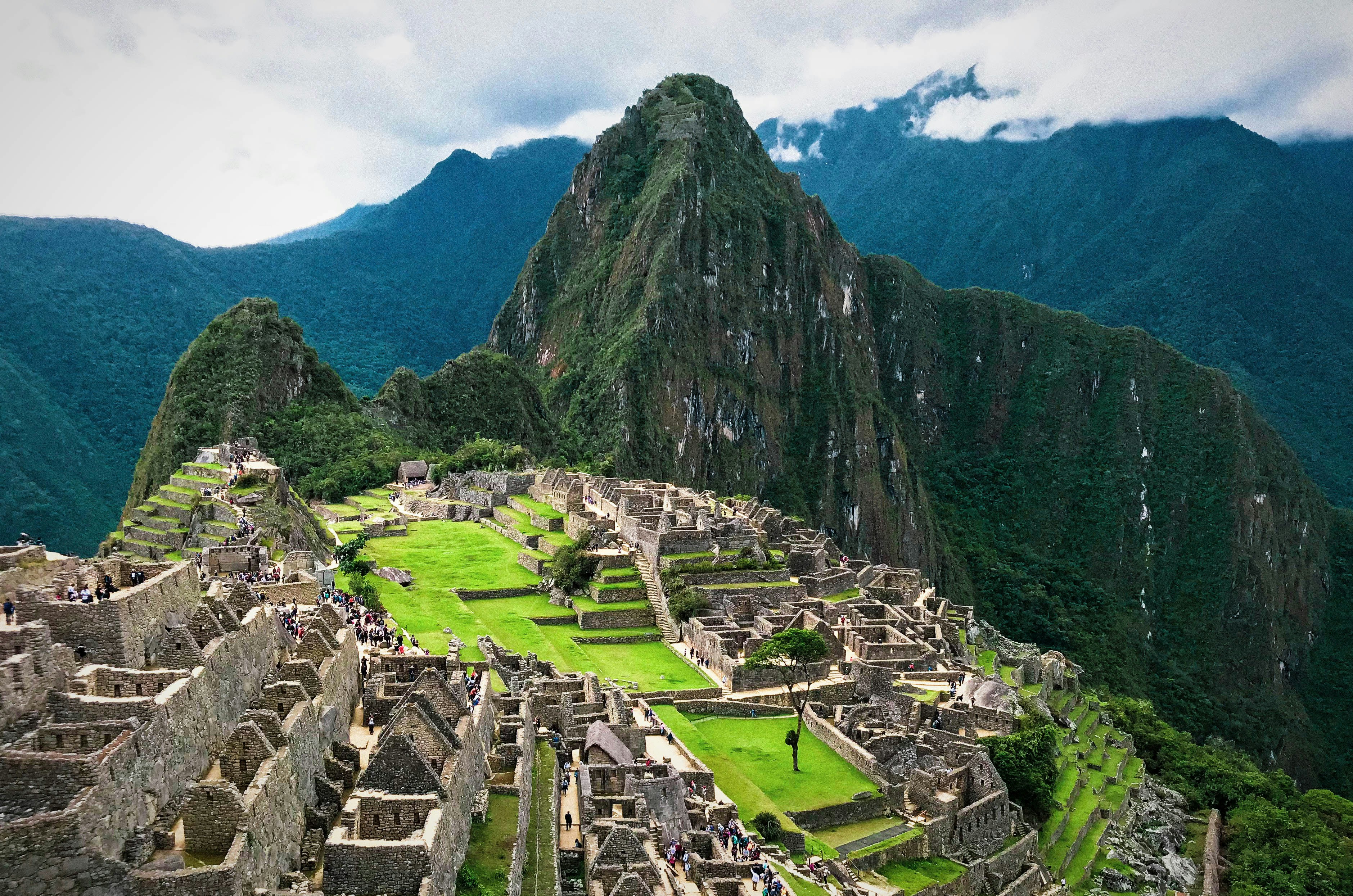 Photo by Eddie Kiszka on Unsplash
Many archaeologists think that Machu Picchu was constructed for Inca Emperor Pachacuti (1438-72) it is the most famous Inca icon and is wrongly referred to as “Lost City of the Incas”. It was - although know locally - unknown to the world until American historian Hiram Bingham “rediscovered” it and introduced it to the world in 1911. It was built in classical Inca style with polished dry-stone walls. The three primary structures are the *Intihuatana*, (ritual stone associated with the astronomic clock or calendar of the Inca) the *Temple of the Sun* and *the Room of Three Windows*. These were dedicated to Inti, their sun god and greatest deity. Many outlying buildings have been restored to give a better idea to tourists of how they originally looked this restoration continues to the present day. In Quechua language *machu* means “old” and “old person” and *pikchu* meaning either “portion of coca being chewed” or “pyramid, pointed multi-sided solid cone” as a result the name of the site is sometimes interpreted as “old mountain”.
In 1911 American historian and explorer Hiram Bingham travelled the region looking for old Inca capital and was led to Machu Picchu by a villager Melchor Arteaga. Bingham found the name Agustin Lizarraga and the date 1902 written in charcoal on one of the walls. Although he was not the first to visit the ruins he was considered the scientific discoverer who brought Machu Picchu to international attention. He organised another trip in 1912 to clear the site and between 1915 and 1915 many artefacts were removed from the site and transported back to Yale University.
In 2006 Yale returned some of the pieces but kept most claiming they were supported by the federal case law of Peruvian antiquities. In 2007 Peru and Yale agreed on a joint travelling exhibition and the construction of a new museum and research centre in Cusco. Yale acknowledged Peru’s title to all the objects but would share rights with Peru in research collection with some remaining at Yale for continuing study. The final batch of artefacts was returned in 2012.
In 1981 it was declared a Peruvian Historic Sanctuary. In 1983 it was declared a UNESCO World Heritage Site having been described as “an absolute masterpiece of architecture and a unique testimony to the Inca civilisation”.
**Did you know?** In 2007 it was voted one of the New Seven Wonders of the World in an internet poll.